Quad City Challenger ultralight building tips
|
|
|
|
|
|
|
|
|
|
|
|
Click here for this months specials! |
|
|
 |
|
|
Some building tips for the Quad City Challenger.
|
|
Challenger Builder's Corner
The following photos and ideas are purely our own. It
works for us but you are ultimately responsible for the work and
applicability to your plane.
 This
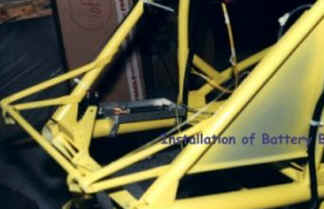
battery box is built with aluminum angle. You need to heat the aluminum
and bend slowly to avoid cracking or breakage. This installation only
works if you are installing the fiberglass nosecone as the battery box
sits slightly outside the framework. This position is really
accessible. This
battery box is built with aluminum angle. You need to heat the aluminum
and bend slowly to avoid cracking or breakage. This installation only
works if you are installing the fiberglass nosecone as the battery box
sits slightly outside the framework. This position is really
accessible.
Note the aluminum sheeting attached to
the inside left of the fuselage. This is where the buss bar is mounted. We
use wire wrap around all the wiring and bring it around the outside of the
aluminum sheet to keep the cockpit neat. We always shoot the fuselage with
primer and finish coat before covering for a nice finished appearance. The
inside of the nosecone will also be painted (use a roller). You
must remove paint where you will have glue surface.
|
| |
|
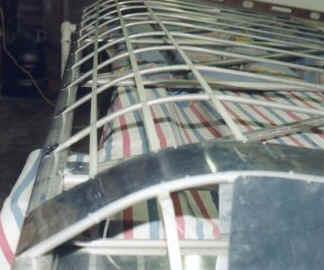
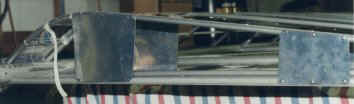 For added strength, we use aluminum
sheet to gussett the ribs to the bottom of
the wing in the inboard box of the
wing. We also make an additional box at the
outboard (only 3-4" wide inside the last rib). We feel this
helps keep the last rib aligned and stable in the shrinking process. For added strength, we use aluminum
sheet to gussett the ribs to the bottom of
the wing in the inboard box of the
wing. We also make an additional box at the
outboard (only 3-4" wide inside the last rib). We feel this
helps keep the last rib aligned and stable in the shrinking process. |
| |
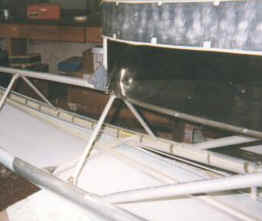
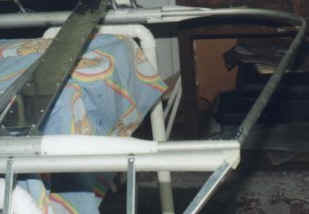 We were in the process here of setting
the hinges for the ailerons.
Notice the portable sawhorses? Using PVC
pipe and fittings you can make them to fit the height you desire to work
at ...and disassembly and storage is easy. Make a great work space by
using a sheet of plywood to bridge . We were in the process here of setting
the hinges for the ailerons.
Notice the portable sawhorses? Using PVC
pipe and fittings you can make them to fit the height you desire to work
at ...and disassembly and storage is easy. Make a great work space by
using a sheet of plywood to bridge .Also notice that we generally spread
sheets across any surface that will contact aluminum to prevent any
abrasion that would open it up to corrosion. (Visit Goodwill...sheets are
cheap, corrosion isn't.)
|
|
|
|
|
|
|
|
The above courtesy of: http://technet.nwidt.com/~cbottjen/Frames/builder.html
|
|
|
|
|
|
Ultralight
News
By Appt. ONLY!
Airfield
|
|
|
|
Ultralight Aircraft News Web Magazine .
You may link to these pages or print
them out for your own personal use, but no part of this
publication may be copied or distributed, transmitted, transcribed,
stored in a retrieval system, or translated into any human or computer
language, in any form or by any means, electronic, mechanical,
manual, or otherwise, without the written permission of Ultralight News.
By copying or paraphrasing the intellectual
property on this site, you're automatically signing a binding contract
and agreeing to be billed $10,000 payable immediately. Copyright Ultralight News
|
|
Return
to Main Index for this section |
|
|
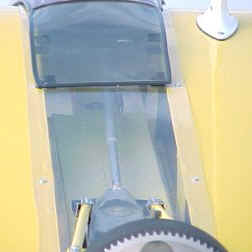
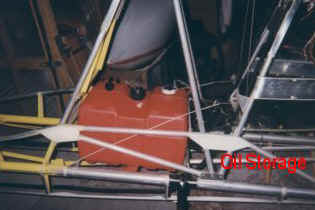 This
particular plane is outfitted with a 12 gallon tank. Behind the tank there
is a small storage compartment formed out of lexan and the same width as
the fuselage. This is for oil storage.
This
particular plane is outfitted with a 12 gallon tank. Behind the tank there
is a small storage compartment formed out of lexan and the same width as
the fuselage. This is for oil storage.