H2 Honey
Bee, Bert Howland's H2 Honey Bee bi-plane, from Classic Aero
Enterprises, H2 Honey Bee ultra lite
plane, Ultralight News
newsmagazine.
|
|
Single place Part 103 ultralights in the United States are defined as single
place ultralight aircraft that weigh 254 lbs or less, have a stall speed
not more than 24 knots, a top
speed of 55 knots, and carry no more than 5 gallons of fuel. To fly a
legal Part 103
ultralight aircraft in the United States the pilot does not require a
pilot license.
Single place aircraft weighing more than 254 lbs. in the U.S. require a
pilots license and must be built as experimental, amateur built,
homebuilt aircraft. These include weight shift aircraft, more commonly
known as trikes, powered parachutes, and powered para-gliders.
Single place ultralights in Canada can weigh up to 1200 lbs. and an
ultralight pilots license is required to fly them. |
|
|
|
|
H2 Honey Bee
ultralight, H2 Honey Bee ultralight aircraft, H2 Honey Bee ultra lite
plane, experimental amateur built aircraft.
|
|
The H2 Honey Bee is an open cockpit single
seater. The fuselage and wing construction is all aluminum
covered in standard aircraft covering materials..
The H-2 is a strut- and cable-braced aerobatic
biplane with four, equal-span, 8-footwing panels, designed to
handle G-loads of +8 to -6.
The prototype and early versions used engines
in the 40-46 horsepower range, but Bert Howland the designer
later moved up to an engine of 65 horsepower as standard.
The plans provide a four aileron option for
those who wish a more responsive roll rate.
|
|
|
When that option is selected, together with an
engine in the 85 horsepower range or better (such as the Hirth
F-30)and with an inverted fuel system, the H-2A is suitable
for use in competition aerobatics up to the International
Aerobatic Club's "intermediate level."
In 1992, an H-2A Honey Bee was named "Best" in
the combined Ultralight/Lightplane category during the EAA East
Coast Fly-in at Wilmington, Delaware.
When a larger engine is combined with
the four ailerons the Honey-Bee is nimble enough to handle most
aerobatics!
Raw materials kits available from Wicks
Aircraft Supply.
CLASSIC AERO ENTERPRISES
343 Wrexham Ct.,
Hampton VA 23669 |
|
|
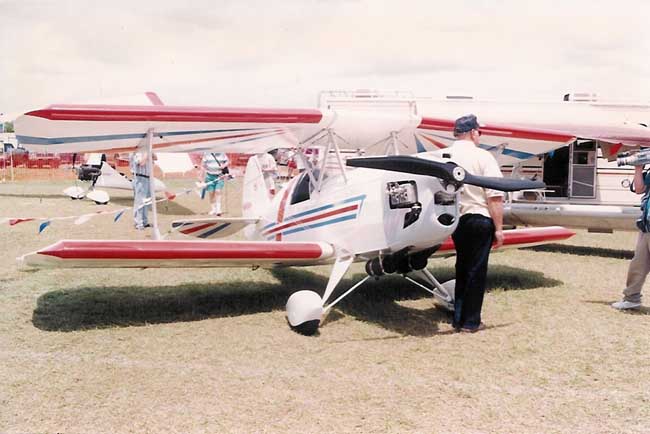 |
H2 Honey Bee
ultralight, H2 Honey Bee ultralight aircraft, H2 Honey Bee ultra lite
plane, experimental amateur built aircraft.
|
|
|
|
|
|
|
|
|
|
Ultralight News Web Magazine.
You may link to these pages or print
them out for your own personal use.
No part of this
publication may be copied or distributed, transmitted, transcribed,
stored in a retrieval system, or translated into any human or computer
language, in any form or by any means, electronic, mechanical,
manual, or otherwise, without the written permission of Light Sport
Aircraft Pilot News.
By copying or paraphrasing the intellectual
property on this site, you're automatically signing a binding contract
and agreeing to be billed $10,000 payable immediately. Copyright Ultralight News. Email
|
|